Find the funders who will actually read you
Most private foundations never read an unsolicited proposal. They say so on their own tax returns, in a box most people never see. Quillify reads those filings so you can spend your weeks on the funders who are genuinely open.

Start by ruling things out
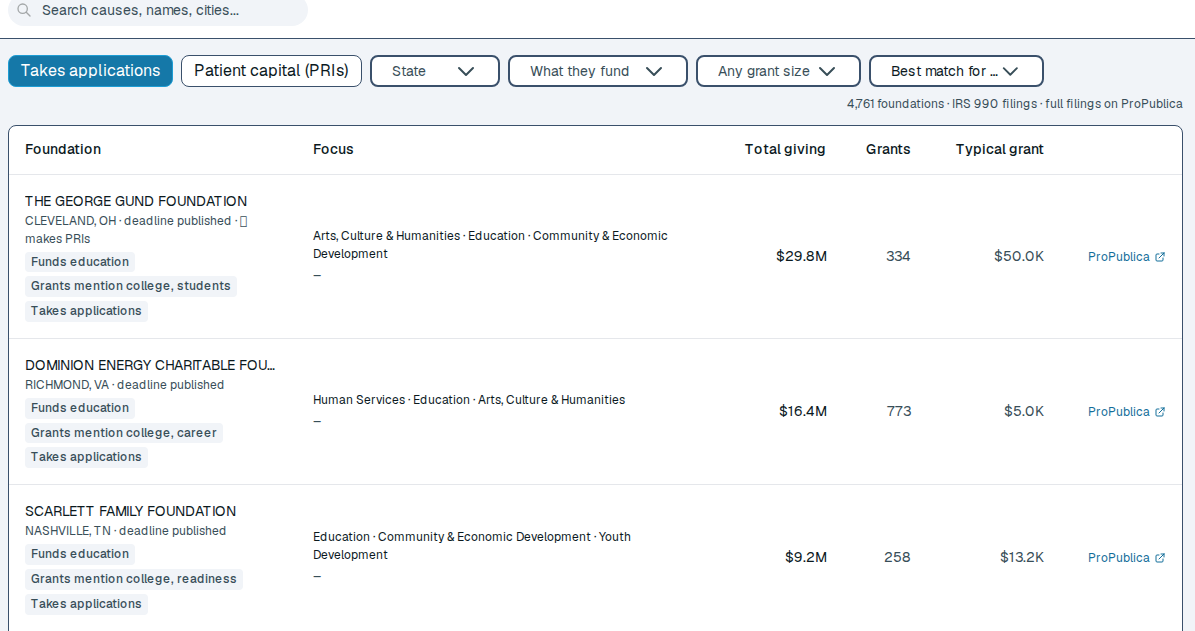
Roughly seven in ten private foundations do not take applications at all, according to their own 990s. They fund charities they have already chosen. Nothing you write will change that, and their giving history will not warn you, because the answer is in a part of the filing almost nobody reads.
We read it for you. 20,000+ funders in our data explicitly accept applications, out of 129,000+ on file.
Watch it happen
Going from nothing to a shortlist you are actually eligible for.
See who funds organizations like yours
The professional move is to work backwards. Instead of hunting opportunities, find the funders already giving to organizations like yours, and start there.
Name a peer organization, or paste a list of them, and Quillify shows every foundation on file that funds them, and which of those have not funded you yet. That gap is your prospect list, and it is built from 2,000,000+ organizations in the IRS registry.
Canadian charities are covered too. Switch the nonprofits view to Canada and search all 83,000+ CRA-registered charities. For 51,000+ of them, Quillify shows the charitable funders behind them, drawn from CRA T1236 filings. Those filings have no reporting floor, so small community grants that stay invisible in US data are visible here, in Canadian dollars. T1236 reports gifts from other registered charities; government and corporate funding show up through the main search instead.
Ukrainian organizations are covered too. 210+ grants for Ukrainian nonprofits and businesses from EU, UK, UN and Ukrainian sources sit in the same search, with titles and summaries in English, amounts in US dollars beside the original currency, and the list refreshed monthly.
We also tell you how confident to be in each match. A grant listed on a funder’s Schedule I carries the recipient’s tax ID, so the match is exact. A 990-PF carries no tax ID at all, only a name, so the best anyone can do is match on the name. We show you which kind you are looking at rather than presenting both as the same thing.
Find the doors your board can already open
Grants follow relationships. Most organizations have warm paths to funders sitting in their own board roster, with no way to see them.
Paste your board list and Quillify checks every name against the officers and trustees on the filings of 129,000+ foundations. Each match is a warm lead: a foundation where someone on your board may already have a relationship, with that funder’s full giving profile one click away. Names can coincide, so verify the connection with your board member first; the profile gives you what you need for that conversation, and for the ask that follows it.
Three kinds of money, one search
Grant databases stop at grants. A lot of the money organizations actually need is somewhere else, so Quillify covers it in the same search.
- 12,000+ open government contracts
- From SAM.gov, which carries federal contracting for all 50 states, plus the procurement portals of 34 states directly, refreshed daily, searchable by set-aside, industry or solicitation number. 72,000+ tracked in total. Selling a service to government is a different game from asking for a grant, and most tools in this category do not play it at all.
- 480+ community lenders
- Sometimes the honest answer is that a grant is the wrong instrument and patient capital is the right one. Community development financial institutions lend below market, and foundations make loans, guarantees and equity investments too. You should at least know they exist.
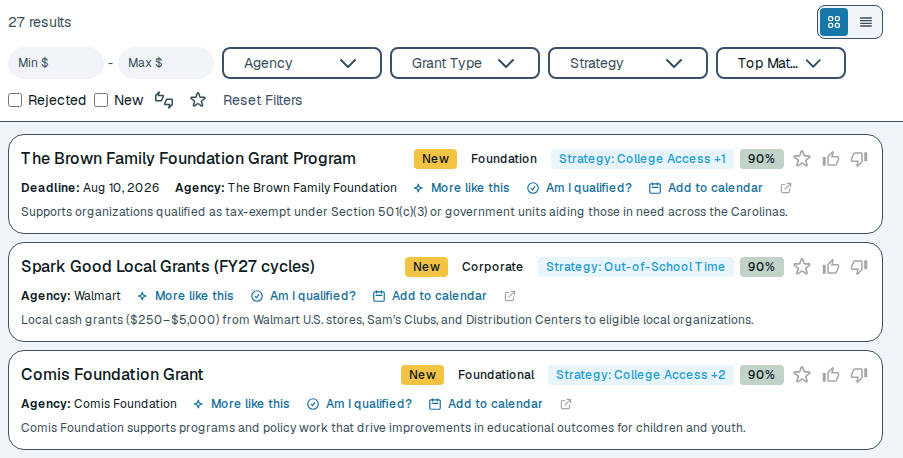
- 4,300+ open grants
- Federal, state and private, with expired listings flagged rather than left to waste your afternoon.
Then find out if you qualify, before you commit
Finding an opportunity is the easy part. The expensive mistake is spending a week on one you were never eligible for.
Ask “Am I qualified?” on any opportunity and Quillify reads the actual announcement rather than a summary of it, then tells you where you stand. If the announcement gives it nothing readable, you get your credits back, and your team can re-open the answer for free.
Federal recommendations carry a funding-precedent check. Each one is judged against more than forty years of SBIR and STTR awards and recent federal spending records, and wears a plain verdict: strong funded precedent, some, or none. Opportunities with precedent sort up, the same check runs inside the eligibility answer, and the answer honors the applicant type you searched as, so a university spin-out checking as a small business is read as one.
See the whole loop, or what each step costs. You can also browse the funder directory without an account, search the grant database, or start from who funds your field.
Find out who would actually fund you.
Browsing and keyword search are free, and there is no card required.