Write it without handing over the thinking
Quillify drafts complete proposals, including the largest federal solicitations. It does that from documents you already have, and it tells you at every step what is still yours to do.
What actually happens
It reads before it writes
The announcement and the documents you select are read in full, repeatedly, through research, compliance checking and review. Cost follows how much you attach, not how long the finished proposal is.
What stays yours: You choose the documents. A tight, relevant set produces a better proposal than everything you have ever written, and costs less to run.
It drafts from your material, not from nothing
Your past proposals, program descriptions, budgets and evaluation data become the substance. The facts in the draft are facts you supplied, and that includes images, charts and scanned pages, which are read rather than skipped.
What stays yours: You supply the evidence. Nothing invents a version of your organization that does not exist.
You revise in plain language
Say "make the budget narrative more specific" or "add our new partnership" and it edits those sections and leaves the rest untouched. Your previous version is kept, so a revision cannot lose work you wanted.
What stays yours: You direct it.
Every proposal comes with a compliance checklist
Each requirement, where it is addressed, the risk of missing it, and the deadline. Rows can be assigned to teammates and ticked off together, and everyone in the organization sees the same list.
What stays yours: The column that matters most is the one headed what your team must do itself. Software cannot sign your assurances, produce audited financials, or secure letters of commitment.
It grades the draft before you send it
The evaluator scores the proposal against the announcement the way a reviewer would, including a three-minute skim test, and hands back a prioritized list of what is weak. If Quillify wrote the draft, it can apply the fixes itself.
What stays yours: You decide what to accept. A score is a coaching tool, not a verdict.
Shorter documents draft too. Letters of inquiry, capability statements, partner letters and commitment letters are written from your organization profile and saved to your Data Room, and any fact Quillify does not have is marked for you to fill in. See what each one costs.
Writing for a second funder? Here is what carries over and what to rewrite.
What it costs, and what drives it
From about credits, scaling with how much source material you attach, because reading is the work. Revisions are much smaller, 3 to 4 credits, since they only re-read the sections you asked to change.
Before it starts, the estimate appears on the button you are about to press. See the cost of every action.
Watch it happen
Responding to a request for proposals with a draft built from your own material, on the day you found it.
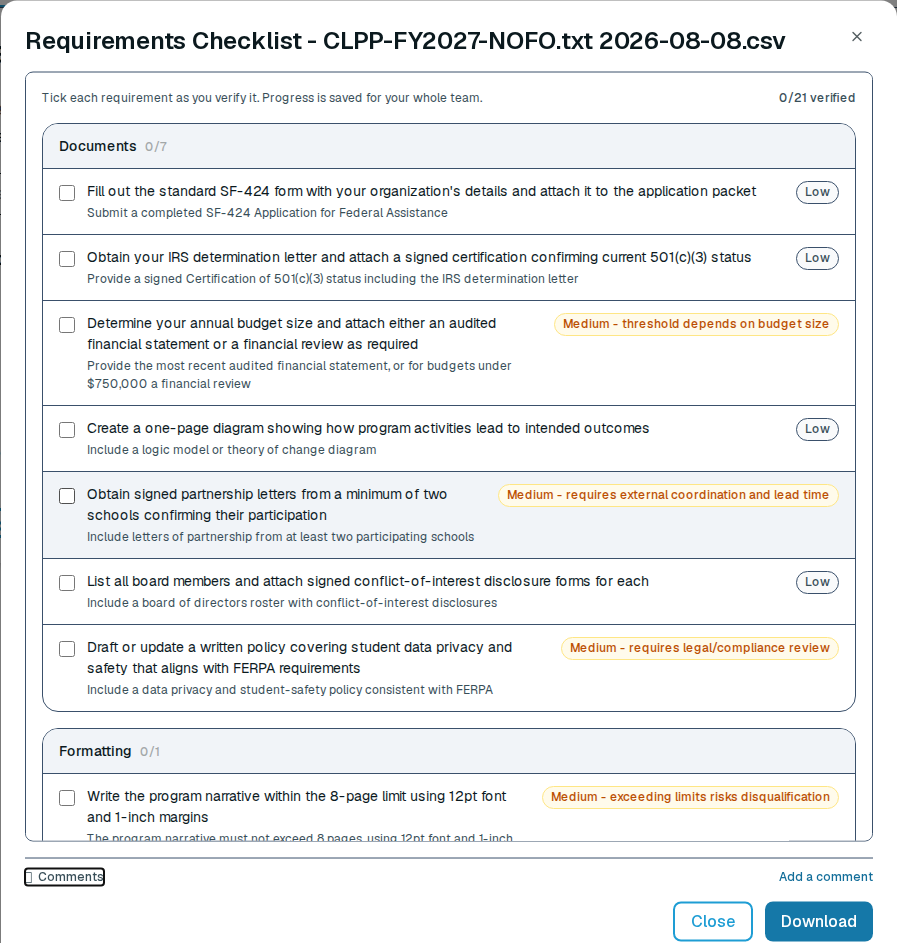
What the checklist actually looks like
Twenty-one requirements out of one announcement, each traced to the line that produced it. Every row says what your team must produce and the risk of missing it, with the reason spelled out.
Where funders stand on this
Some funders have started publishing policy on AI-written applications, and reviewers have opinions whether or not their agency has. You should know that before you buy software from us, not after.
Read what the funders actually say, or see how each funder treats AI.
Start with a proposal you were going to write anyway.
Browsing and keyword search are free, and there is no card required.