Ask one question, across everything
Most funding tools give you a search box per dataset and leave the joining up to you. You search foundations, then search grants, then open a spreadsheet, then try to remember what you found on Tuesday. The work is not the searching, it is the holding it all in your head at once.
Lil’ Q takes a question in plain language and reaches whatever it needs to answer it, including several sources in a single question.

Lil’ Q, the one doing the reaching.
The kinds of question that work
Real examples instead of a feature list, because the difference between a good and a useless answer here is mostly the shape of the question.
- "Which foundations near us fund after-school programs, and do any of them take applications?"
- Two datasets in one question. It reads the funder corpus for the subject and the geography, and the application-status field that tells you whether an unsolicited approach is read at all. The answer is a shortlist, not a list.
- "What does this funder usually give, and to whom?"
- Not their stated priorities, which are aspirational, but where the money actually went: their largest grants, the typical size of one, and the focus areas derived from their own filings. Ask for a specific foundation and you get its application instructions with it.
- "Is there anything open right now that fits what we did last year?"
- Live grants and contracts, with expired listings excluded, weighed against the material already in your Data Room.
- "Who has funded Feeding America?"
- Name any organization, or give a tax ID, and it will tell you which funders have backed them and for how much. Instead of hunting opportunities, start from the funders already giving to organizations like yours.
- "What did that opportunity I looked at last week require?"
- Your own search history and saved matches are part of what it can read, so you do not have to remember which one you meant or start the search again.
- "What is a cooperative agreement, and should we want one?"
- General questions work too, and it will search the web when the answer is not in your data. Useful when what is blocking you is vocabulary, not information.
Notice what it is doing there
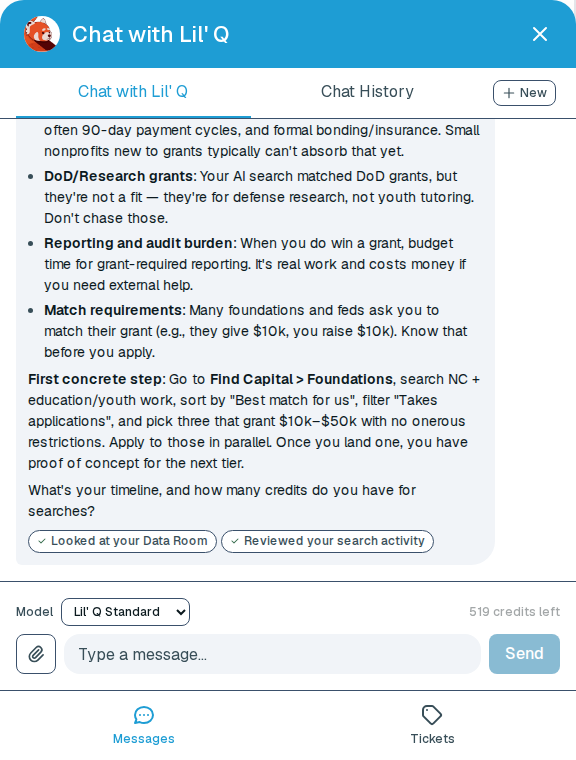
Four of the five things in that answer are reasons to be careful, and one is an instruction to stop: the defense research grants its own search surfaced are not a fit, so do not chase them. Then a concrete first step, and the sources it used.
That is the behavior the rest of this site claims and it is easier to show than to argue. A tool that only ever finds you more to apply for is making your problem worse.
What it can reach
129,000+ funders, built from tax filings. Searchable by subject, place or name, and you can pull one up directly for its application instructions, its largest grants, the usual size of a grant, and the areas it actually funds.
4,300+ open grants and 12,000+ open contract opportunities. Searched by meaning, not by keyword, with expired listings left out.
Your own work. The documents in your Data Room, the searches you have already run, the matches you saved, and the conversations you have already had.
The open web, when the answer is not in any of the above.
Who funds an organization you name. Give it a name or a tax ID and it will tell you which funders have backed them. The professional move is to work backwards from organizations like yours instead of forwards from opportunities, and this is that, in a sentence.
Two things that live elsewhere in the product
Write the whole proposal. It can pull documents together and get you started. A full draft is a different piece of machinery and you start it deliberately. How that works.
Investigate forever. There is a budget on how far one question can chase itself. Ask something sprawling and it will ask you to narrow it. It does not disappear for an hour. In practice that is a feature, and better known in advance than discovered.
What it costs
Differently from everything else, and in your favor for short questions. A conversation bills by how much work the question actually takes rather than at a flat rate per message. A quick clarification costs a fraction of a credit. A deep investigation across several datasets costs more than that.
That is why you will not find it as a row in the credit table, where everything else has a fixed price. Every fixed-price action is published there, including the flat 5 credits for an AI capital search.
Ask it something you would otherwise have researched.
Browsing and keyword search are free, and there is no card required.