
Nobody gets left behind
If you are accountable for funding outcomes across organizations or people you do not directly control, you already know the problem. You cannot write everyone’s proposals. You cannot see who has quietly stopped trying. And someone is going to ask you how the program is going.
The same job, under four different titles
A research development office is responsible for its professors. A council of governments is responsible for its municipalities. An accelerator or chamber is responsible for its member companies. A funder making program-related investments is responsible, in a looser but no less real sense, for the nonprofits it backs.
All four are measured on outcomes produced by other people. All four have the same fear, and it is not that the program will fail. It is that one specific member will fall through the middle of it without anyone noticing.
What the admin view shows you
- Who is applying, and who is not
- A table across every member organization: applied, won, lost, pending. The members sitting at zero are visible by scanning one column, which is usually the first useful thing a portfolio manager learns. Nothing pushes an alert at you when someone goes quiet, so nothing lands in your inbox. You go and look when you want to know.
- Readiness across the whole cohort
- Average readiness score, and the distribution behind it, so you can see whether you have a handful of strong members and a long tail, or an even spread. Category averages break it down across market, capital, intellectual property and operations, so you learn what kind of help your members need, not just how much.
- Dollars requested and awarded
- Columns for what members asked for and what they won, rolled up across the cohort. These are populated by members recording outcomes, so the roll-up is as complete as the logging behind it. Worth knowing before you promise your board a figure.
- Onboarding, per invitation link
- How many people you invited, how many actually onboarded, per share link. The quiet failure in every cohort program is the members who never started, and this is where that shows up.
- A shared credit pool
- You fund the work centrally. No member organization has to find a budget line of its own. For a sponsor whose members are small nonprofits or early-stage companies, this is often what makes participation possible at all.
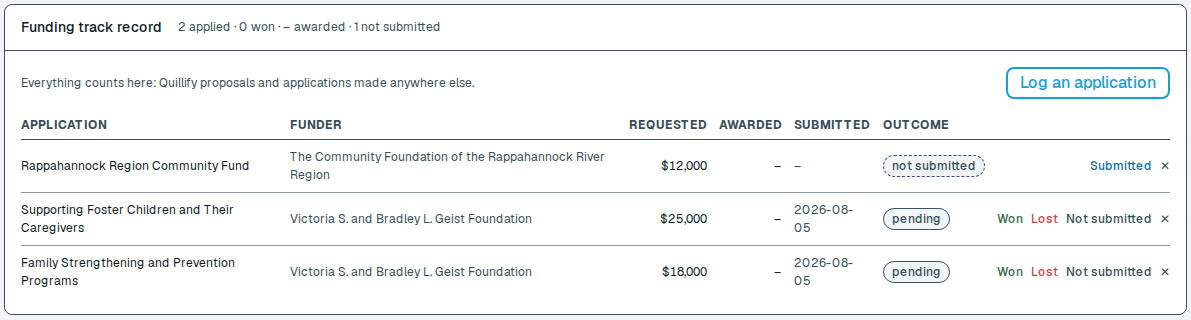
That is a demo organization mid-cycle, not a success story. Two applications pending, one not yet sent, nothing won. It is what the tracker looks like most of the time, and it counts applications made outside Quillify as well as through it.
Your members’ work stays their own
You cannot read a member’s work. Clicking a member does not open their proposals or their documents, and there is no code path that would let it. You see the scoreboard, never the work product.
That boundary is usually the answer to the question your members are too polite to ask you. Their drafts stay theirs. If they want you to see something, they share that file with you, and they can revoke it. The enforcement is worth reading about, because enforcement in code is what turns that promise from a policy into a fact.
If you are deploying money, not running a program
Foundations making program-related investments, community foundations, and individual donors all run into the same ceiling: the amount you can give is the amount you can give. A funder putting $50,000 across ten nonprofits would far rather those ten each raise another $200,000.
That is what this is for. You are not buying software for your own use, you are buying leverage on money you already deploy. And the same product surfaces the patient capital that gets overlooked entirely, foundations making below-market loans, guarantees and equity, which almost nobody in this category covers.
Getting a cohort started
Members join through a link you control, with access privileges attached, so they are set up correctly without you administering accounts one at a time. Pricing is custom, because cohorts differ by an order of magnitude in size and in how much credit they need.
This is the one page on this site where booking a call is the right next step. Everywhere else it would be a way of dodging a price. Everyone else can start from zero.